First look at Meshtastic in Vilnius
I’d heard about Meshtastic for a while but didn’t get around to trying it until I planned a mountain ski trip with friends - where potentially, even though unlikely, cell service could be spotty. That finally gave me an excuse to pick up a handful of nodes and test it myself.
Does it work as promised? What's the mesh like in my local area? Can I actually use it for off-grid comms, and what is the user experience like? Does it actually help communicating and geolocating while skiing?
I won't go into exact details for all the configuration options and nitpicks - this is a more general overview of the initial experience that can fit into a single post.
What is Meshtastic, anyway? #
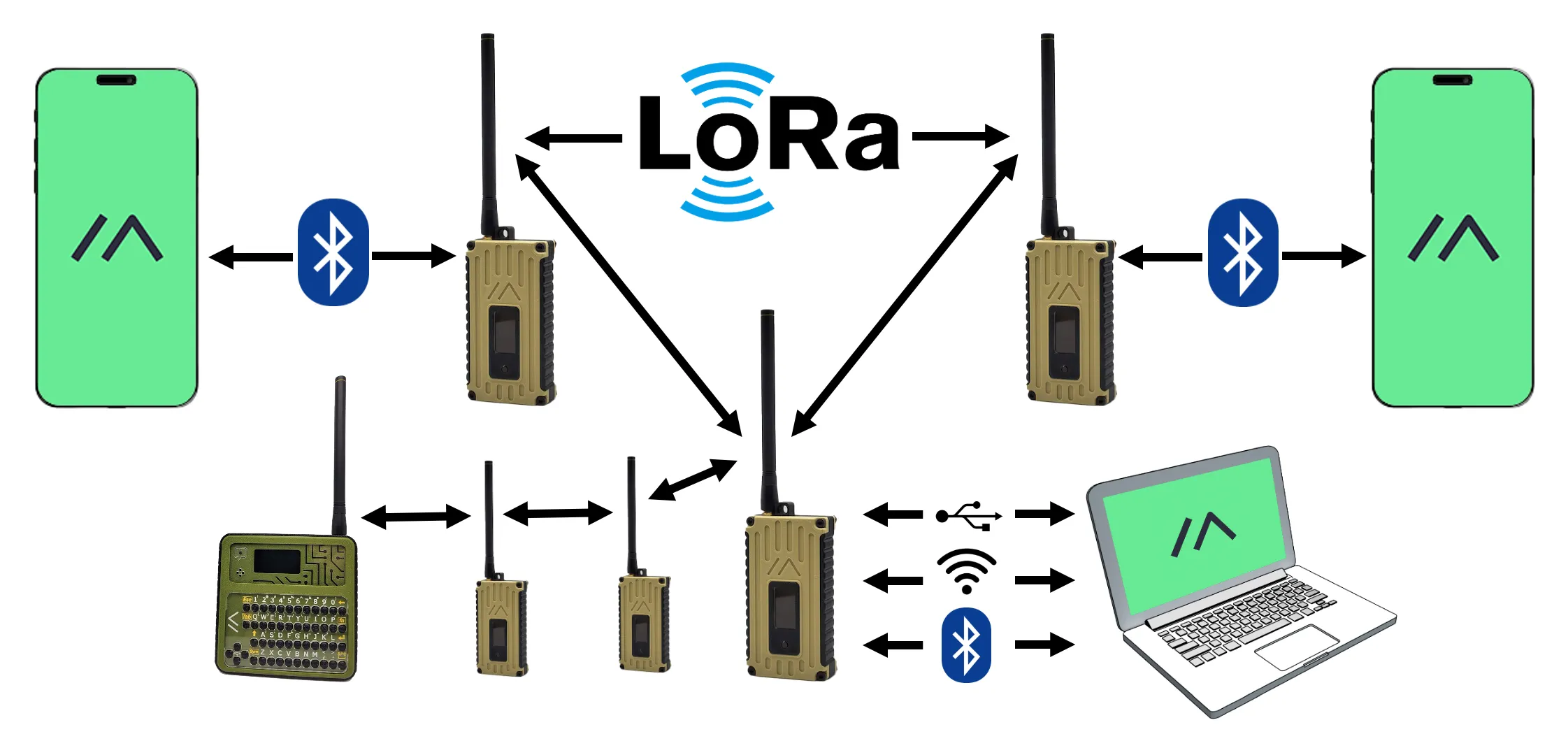
I'll just directly quote the Meshtastic docs, they have a great explanation:
Meshtastic® is a project that enables you to use inexpensive LoRa radios as a long range off-grid communication platform in areas without existing or reliable communications infrastructure. This project is 100% community driven and open source!
...
Meshtastic utilizes LoRa, a long-range radio protocol, which is widely accessible in most regions without the need for additional licenses or certifications, unlike ham radio operations.
These radios are designed to rebroadcast messages they receive, forming a mesh network. This setup ensures that every group member, including those at the furthest distance, can receive messages.
Many Meshtastic radio devices, called "nodes", are deployed unmanned/unmonitored with solar panels and batteries in key locations - allowing for true off-grid functionality in cases of power grid shutdowns, with almost no maintenance needed to keep them up.
Nodes can use GPS modules to track and announce their location, assisting in outdoor coordination, search & rescue, or just mesh network planning.
What is the purpose of this again? #
Kevin created Meshtastic at least partially for various nature activities like hiking1.
Many people have an interest in it for a variety of purposes:
- Existing interest in radio tech (HAM radio operators, radio newbies who don't want to use short-distance unlicenced radios, but don't have a licence for long-range).
- Outdoor, poor cell signal activities (tracking and communicating in the wilderness, when hiking, etc).
- Off-grid independence (privacy and emergency preparedness enthusiasts).
- Actual use during emergencies and disasters2.
In my case, I hope to be able to use my nodes to reliably track GPS positions among skiing friends, and allow coordinating breaks - even if cell service is unavailable.
Getting the hardware #
There's a wide variety of hardware you can use with Meshtastic. Designed to be relatively low-cost and DIY'able, devices use mostly off-the-shelf components, all glued with the Meshtastic firmware. Users often build their own nodes from smaller components (microcontroller board + LoRa radio + antenna, DIY cases) or buy preassembled nodes as commercial offerings.
I ordered four different devices to get a feel for various form factors and features (making sure to get aftermarket antennas where I could, as recommended by the community):
LILYGO T-Echo3 #

Often recommended as a great all-around, out-of-the-box beginner-friendly node.
Features:
- External antenna connector, allowing for great reception (and an aftermarket antenna)
- E-ink display
- GPS module
Cost me €62 + €8 for the antenna (868 MHz SMA version) (both including shipping)
SenseCAP Card Tracker T1000-E4 (x2) #

Card-sized, amazing form factor and price for a preassembled node, reportedly with decent reception.
Features:
- GPS module
- Buzzer for message alerts
- Button - mostly for muting message alerts and turn GPS on or off
- Slim form factor for everyday carry
Cost me €49 including shipping and snap hook, each.
Heltec LoRa 32 V35 #

Reportedly the most popular and cheap DIY node base. WiFi capability is great for adding an MQTT-uplink-enabled node, if I can supply it with mainline power.
Features / drawbacks:
- 0.96 inch OLED display
- WiFi
- Power hungry
- No battery or case included
Cost me €24 for the board, + €8 for the antenna incl. shipping (868 MHz SMA version).
The smaller 803048 1200mAh handheld battery intended for this 3D-printed case cost me €7;
A bigger 18650 3450mAh battery for this desktop 3D-printed case cost me €8 including a battery holder.
First impressions in Vilnius #
Once I received the first node, I just set it up with some default parameters and immediately saw a surprisingly healthy mesh in the capital.
It took a while for all of the node announcements to get collected (usually sent at intervals of anywhere between 15 minutes to several hours), but one can essentially observe what I feel like is the whole span of the city with just one of these handheld nodes, a basic aftermarket antenna, and decent positioning (my high-floor apartment and a window gave me good reception).

I can only reach 4+ nearby nodes directly, but that's the beauty of the Meshtastic mesh - those four can route and forward packets, ensuring I have full access to the overall mesh.
Based on what I observed, the number of nodes I can reach by amount of "hops" (amount of nodes in-between that route and forward packets) is as follows:
| Hops | Nodes Reachable |
|---|---|
| 0 (direct) | 4 |
| 1 | 12 |
| 2 | 28 |
| 3 | 38 |
| 4 | 2 |
| 5 | 8 |
| 6 | 1 |
Public channel activity #
The default public channel is decently active, but only about 5-10% seems to be anything other than short "ping - pong" exchanges and connectivity tests. There's a node that periodically announces the date and weather, though.
Usage #
User experience #
I must say, however, that the UI/UX of Meshtastic apps is very clunky, especially the mobile apps.


Some settings are scattered (for example, the "OK to MQTT" flag appears in the LoRa module settings rather than the MQTT module settings). This seems driven by how the Meshtastic firmware exposes options to clients rather than an app bug, but I'm not sure.
Sure, a determined, at least slightly technical person can figure out how the apps work and how to configure the things you want (especially if you follow the Meshtastic docs, which include explanations for each configuration "module"), but it's easy for me to imagine that for anybody less enthusiastic, Meshtastic can immediately give "this is a nerdy toy" vibes from the UI alone.
However, one must remember that this project is completely free and open-source, and for that - I am thankful it exists at all.
If you don't understand the apps or the documentation, the web is filled with some decent, some great videos and blogs about how to set it up to perform well. Hopefully, as the community grows, both the apps and the docs will get some much-needed polish. For now, expect a bit of a learning curve and don’t be afraid to ask for help in the local groups.
Reliability #
The routing quality also seems to be iffy too. Meshtastic has made great leaps in reliability with many improvements between v2.x patches, but it'd be difficult for me to say that I can rely on my messages to reach specific target nodes.
Sure, I can trust it to deliver to my immediate neighbors, or someone with a great antenna further away - but the reliability falls quickly with each hop.
The underlying protocol and inconsistent UIs in client apps don't help either - as a user, I'm never quite sure whether my node's firmware believes it has a link to a node either, even if there's a huge cluster of nodes in-between us.
Alas, that just might be the price to pay while using low-cost devices on unlicenced, low-power radio frequencies, with heavy airtime restrictions, in a decentralized mesh.
Community #
Speaking of local groups, it's common for countries, counties, cities or other specific areas to host their own online group forums - or, sometimes even websites - for easier local-language guides and collaboration.
The Meshtastic website lists some local groups.
I joined the "Meshtastic Lithuania" Facebook some while ago, but it's been active for almost two years now. Posts are sparse, but at least more in-depth and conversational than on LoRa.

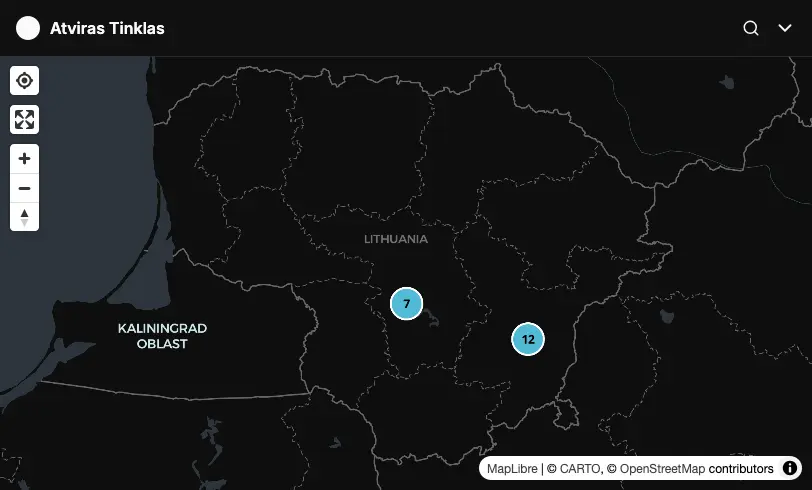
One enthusiast even started building the local community website, atvirastinklas.lt with a bespoke-made map to view the local network topology, which is great to see.
The author welcomes help - I even pitched in to help a bit on documentation and some discussions, hoping it’ll help newcomers place their own devices and spark more conversations beyond simple pings.
Hardware initial impressions and tests #
I'm pretty happy with the nodes I've purchased so far - however, I haven't battle tested them yet for battery life, range, etc.
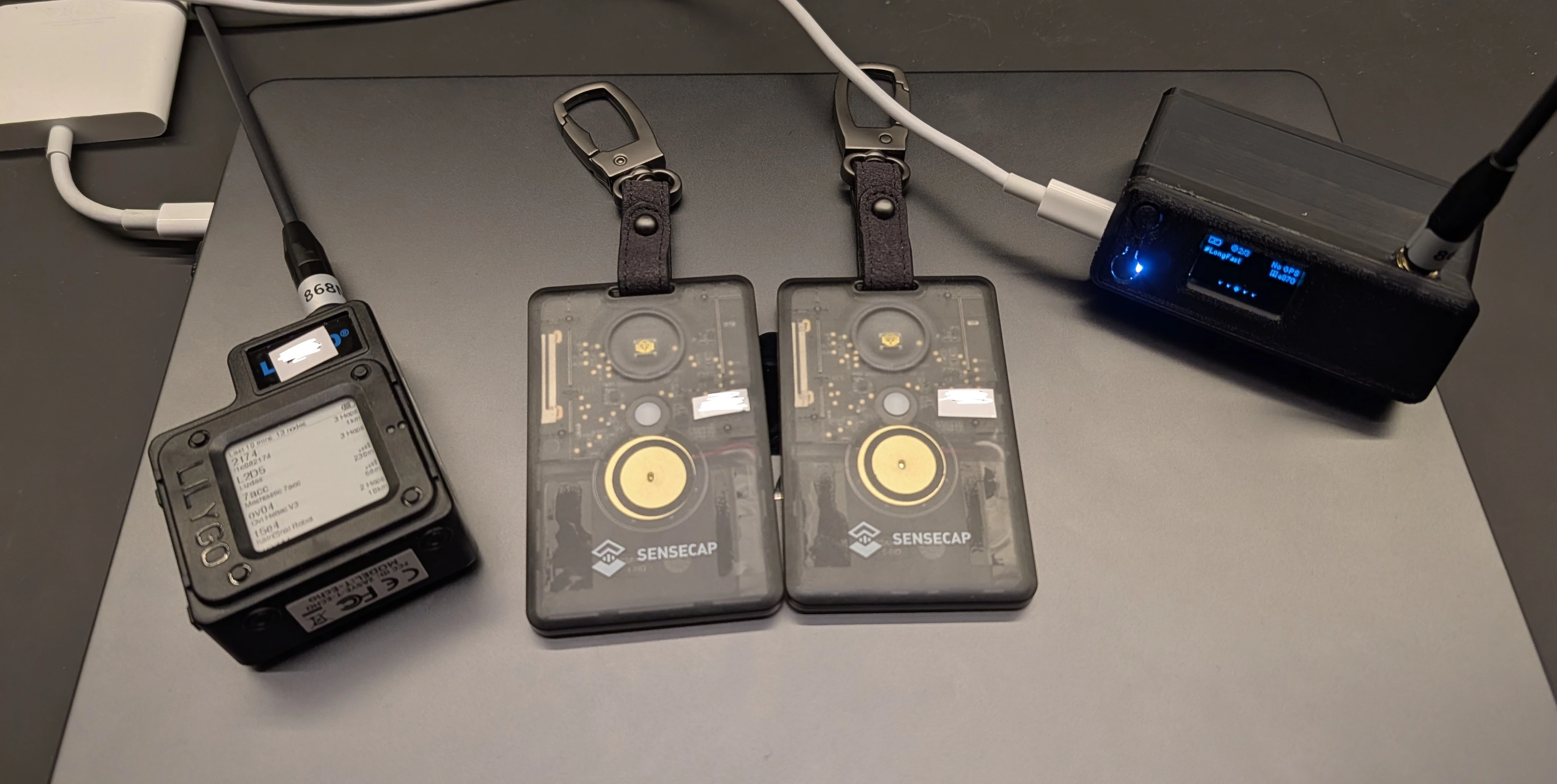
- The T1000-E models feel very premium and great to carry, but I'm somewhat concerned with their performance with lots of objects blocking line of sight. Battery life seems great, can definitely last a day.
- The T-Echo is also great for its form factor - standing unattended next to my balcony, it stays up for at least a couple of days and has great reception due to the antenna.
- The Heltec V3 seems great for WiFi usage (I uplink to my local MQTT topic to get map data), but make sure to plug it into the wall for power (or lower your expectations for battery life).
If you require truly great reception, I'd grab a RAK WisBlock starter kit, a good, chunky antenna, and pair it with an appropriate battery and solar system (the WisBlock modules have direct interfaces for them).
Alternatives #
It's important to note that Meshtastic is not the only available decentralized option, even for LoRa.
The main competitors are Meshcore and Reticulum, but both are much less popular and haven't reached critical mass in Lithuania. From what I've heard, Meshcore is on the rise in west Europe - especially in the UK. It also seems to have more reliable routing and acknowledgements, and a more deliberate mesh topology (you have to select whether your device will be able to forward packets during firmware flashing, for example - among other features).
Even traditional push-to-talk radios can be seen as direct competitors - given the ease of use and familiarity most people have with them. However, the licence-free band PMR446 available in Europe lacks the distance these LoRa-based networks can achieve, especially if you count in mesh forwarding.
What’s Next? #
Overall, Meshtastic proved to be a fun, hands-on way to chat off the grid.
Like many, I immediately start thinking about getting a solar node for range and power independence, but first things first - Meshtastic needs to prove itself to me on difficult terrains first. The ski trip is next on the list. I’m also curious how much different foreign meshes are (some countries have switched away from the LongFast preset).
Reliably mapping out the network topology for a local map seems to also have a lot of nuances and tickery. There's no way to map out direct links (and their quality) between nodes without some sort of drawbacks. If I (or, more likely, the author of atvirastinklas.lt) figure out a way to do it well, expect a post about it too.
If you’re experimenting with Meshtastic in this area too, hop into the Meshtastic Lithuania group and say hello!
Footnotes #
Meshtastic firmware version 2.6.11, default LongFast settings for EU_868.